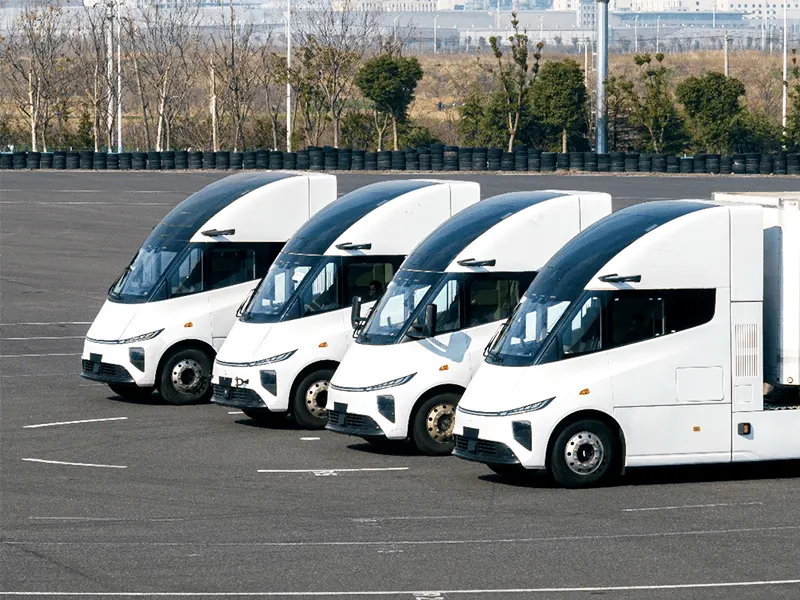
Recently, Xu Changming, a senior economist at the State Information Center, offered insightful views at an industry forum, pointing the way for the commercial vehicle industry, which is at a critical stage of transformation. He identified two core structural opportunities in the commercial vehicle market in 2026: a continuously improving export market and a significant increase in new energy vehicle penetration due to continued policy subsidies.
With the commercial vehicle industry having entered a phase of normalized and stable operation, these two opportunities will not only reshape the market landscape but also accelerate the industry’s transformation from scale competition to value competition.
● 2025 Commercial Vehicle Industry Performance Review
Looking back at 2025, the commercial vehicle industry delivered an impressive performance, laying a solid foundation for structural growth in 2026. According to data disclosed by Xu Changming at the forum, commercial vehicle sales increased by 9.1% year-on-year from January to November 2025, with heavy-duty trucks performing particularly well. Sales jumped from 550,000 units in the same period last year to 735,000 units, a year-on-year increase of 33.5%. Major vehicle types, including light and heavy-duty trucks, significantly benefited from policy dividends.
Looking at the full-year trend, the industry expects sales to reach 4.25 million vehicles, a figure that has remained at a mid-to-high level over the past 20 years, becoming a crucial force supporting the growth of the automotive industry and even the national economy.
It is worth noting that the commercial vehicle market in 2025 exhibited a rare phenomenon of “dual growth in domestic demand and exports,” breaking the previous pattern of “export growth and declining domestic demand.” Exports in the first 11 months exceeded 950,000 vehicles, surpassing the total for 2024, representing a year-on-year increase of 14.5%.
In terms of incremental contribution, the domestic market accounted for 66.9%, while overseas markets accounted for 33.1%. This coordinated growth pattern has injected dual resilience into the industry’s development.
● Exports: A Certainty Growth Engine Under Deepening Globalization
Xu Changming predicts that commercial vehicle exports will continue to maintain a good growth trend in 2026. This prediction is not unfounded but is based on a comprehensive consideration of multiple factors, including the current solid foundation of the export market, changes in the global industrial landscape, and the deepening of corporate internationalization strategies.
From a data perspective, the high growth of commercial vehicle exports in 2025 has become a clear trend, especially in the heavy-duty truck sector, with an estimated 332,000 units exported throughout the year, representing a year-on-year increase of 14.3%. Exports to non-Russian regions continue to maintain strong growth. This growth is not a short-term surge, but rather built on core logics such as improved product competitiveness, a well-established overseas market layout, and the release of global demand for new energy commercial vehicles.
Policy + Exports! Opportunities for the Commercial Vehicle Industry Arrive in 2026
The core competitiveness of China’s commercial vehicle exports has gradually shifted from traditional price advantages to technological and product adaptability advantages. In the field of new energy commercial vehicles, Chinese companies have gained a first-mover advantage, and the continuous decline in battery costs has further highlighted the cost-effectiveness advantage of their products. Data shows that battery costs have dropped from 700 yuan per kilowatt-hour two years ago to 530 yuan currently. A 400-kilowatt-hour commercial vehicle can save 80,000 yuan in costs, and the cost savings for a 600-kilowatt-hour heavy-duty truck are even more considerable. Against this backdrop, the acceptance of Chinese new energy commercial vehicles in overseas markets is constantly increasing, becoming a new driving force for export growth.
From a market layout perspective, Chinese commercial vehicle companies have broken free from dependence on a single market and formed a globalized layout. In addition to their traditional advantageous markets, companies are also accelerating their breakthroughs in developed country markets.
Fang Yinliang, Global Managing Partner at McKinsey, pointed out that in terms of scale and specifications, Chinese commercial vehicles have already played a leading role in global industry development. Although they still need to catch up with traditional European automakers in the high-end market, their overall competitiveness is rapidly increasing. With the continuous improvement of overseas service networks and the enhancement of localized production capabilities, the sustainability of China’s commercial vehicle exports will be further strengthened.
Institutional forecasts predict that after the base effect of the Russian market is eliminated in 2026, commercial vehicle exports will accelerate. Under a neutral expectation, the annual export volume is expected to reach 390,000-400,000 units, a year-on-year increase of nearly 19%, with exports surpassing domestic sales to become the core driver of industry growth.
● Policy: Continued Subsidies Will Accelerate New Energy Transition
If exports are the “incremental engine” of the commercial vehicle industry, then the continuation of policy subsidies will become the “accelerator” of new energy transformation.
The strong performance of the commercial vehicle market in 2025 is inseparable from the strong impetus of policies. This year’s early scrapping subsidy policy has been optimized and adjusted in terms of scope and conditions: the scope of scrapping subsidies has been expanded from National III to National IV emission standards, significantly increasing the base amount; natural gas vehicles have been included in the subsidy scope; vehicles scrapped within one year in advance are not eligible for scrapping subsidies but can still enjoy new purchase subsidies; the policy implementation period covers the entire year, and compared to the policy launched in August 2024, its stimulating effect is more significant.
The specific subsidy amounts are considerable: scrapping old vehicles can receive subsidies of 10,000-45,000 yuan, and purchasing new energy vehicles can receive subsidies of 35,000-95,000 yuan. If a new energy vehicle is scrapped and a new vehicle is purchased, the maximum total subsidy can reach 140,000 yuan.
Policy + Exports! Opportunities for the Commercial Vehicle Industry Arrive in 2026
The stimulating effect of the policy is fully reflected in the rapid increase in the penetration rate of new energy commercial vehicles.
Data shows that the penetration rate of new energy commercial vehicles was only 10.6% in 2023, rising to 19.8% in 2024, and exceeding 27.3% from January to November 2025, with the penetration rate soaring to 35.8% in November alone, showing an accelerated upward trend. Heavy-duty trucks and light-duty trucks, as core categories accounting for over 75% of the commercial vehicle market, have become the main drivers of this penetration rate increase. From January to November 2025, sales of new energy commercial vehicles reached 840,000 units, a year-on-year increase of 60%; sales of new energy heavy-duty trucks exceeded 180,000 units, a year-on-year increase of 178%; and sales of new energy light-duty trucks reached 250,000 units, a year-on-year increase of 52%.
From a market structure perspective, the changes in the heavy-duty truck market are particularly profound. In 2023, gasoline vehicles accounted for 70% of new vehicle sales, dropping to 57% in 2024. In 2025, gasoline vehicles accounted for less than half of new vehicle sales, at only 48%, while electric vehicles and natural gas vehicles each accounted for 26%, achieving a qualitative change in market structure within two years.
Xu Changming emphasized that if current subsidies continue in 2026, the penetration rate of new energy commercial vehicles is expected to exceed 40% or even higher.
This assessment is based on the cost sensitivity inherent in commercial vehicles as production tools. Currently, the proportion of new energy vehicles in the commercial vehicle fleet is still relatively low, at around 500,000. However, with the increasing prevalence of new energy commercial vehicles, cargo owners are generally pricing them at the cost of new energy vehicles, leading to persistently high operating costs for gasoline-powered vehicles and making their scrapping and replacement an inevitable trend.
From an application perspective, the penetration of new energy commercial vehicles has shifted from closed to open scenarios: closed scenarios such as mines, steel mills, and ports have matured and are seeing significant growth; short-distance open scenarios such as sanitation vehicles, urban dump trucks, and concrete mixer trucks are rapidly advancing; and even long-haul transportation scenarios exceeding 300 kilometers have begun.
● Challenges Behind the Opportunities: Balancing Scale and Quality
Although two major structural opportunities are clearly visible in 2026, the commercial vehicle industry still faces numerous challenges. How to balance speed and quality, scale and efficiency, has become the core issue for the industry’s high-quality development.
First, the problem of overcapacity remains fundamentally unresolved. Currently, the commercial vehicle industry’s production capacity has reached 5 million units, while market demand only remains around 4 million units. This has resulted in corporate profits failing to keep pace with sales figures, and the industry’s “involution” phenomenon persists.
Even with a market recovery in 2025, the pressure on corporate profitability remains significant.
Policy + Exports! Opportunities for the Commercial Vehicle Industry in 2026
Second, the risk of diminishing marginal returns from policy needs to be considered.
Institutional forecasts predict that by the end of 2025, the number of vehicles meeting only the National IV emission standard and below will still be 470,000-480,000. While the policy is likely to continue in 2026, its stimulating effect may weaken. From the perspective of the domestic market, the policy-driven growth will decline, making the sustainability of natural demand growth crucial. Furthermore, the rapid development of new energy commercial vehicles still faces bottlenecks due to insufficient infrastructure, particularly the inadequate coverage of charging facilities in remote areas and the anxiety surrounding long-distance transportation refueling, which restricts their penetration into broader scenarios.
Finally, industry competition has shifted from scale-based competition to value-based competition, requiring companies to continuously focus on technological innovation, product upgrades, and service ecosystem development.
Faced with the structural opportunities and industry challenges of 2026, leading commercial vehicle companies have already made early preparations, building core competitiveness around three main themes: new energy, intelligentization, and internationalization.
● Summary:
Looking ahead to 2026, the structural growth trend of the commercial vehicle industry is clear, with exports and new energy vehicles becoming the core growth drivers. Continued policy support will inject sustained momentum into the new energy transformation, while deepening globalization will open up new growth opportunities. However, while enjoying the benefits of growth, the industry must adhere to quality standards and achieve a leap from speed to quality through technological innovation, product upgrades, and ecosystem development.