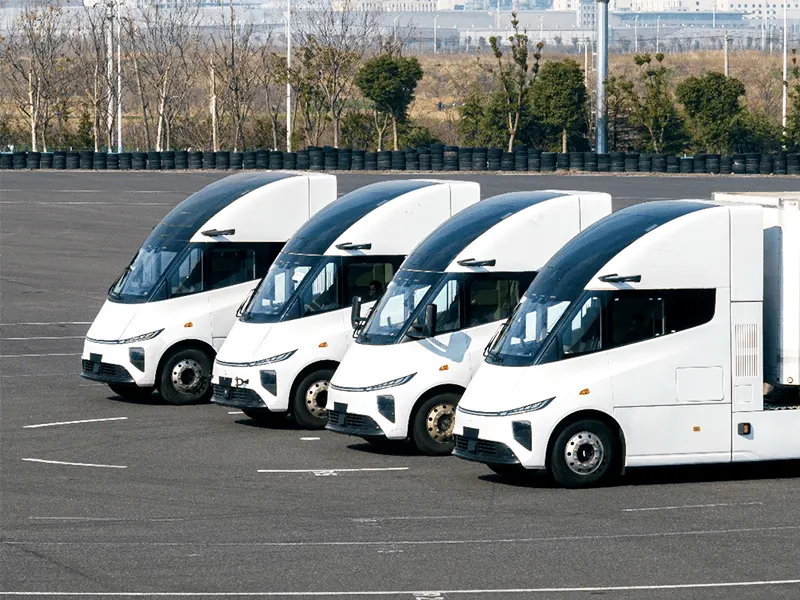
In logistics parks, an increasing number of electric heavy-duty trucks with green license plates are bustling about; in mining areas and ports, new energy heavy-duty vehicles are replacing traditional diesel trucks, a growing trend. Related data shows that in the first seven months of 2025, my country’s cumulative sales of new energy heavy-duty trucks reached 95,900 units, a surge of 179% year-on-year, with a monthly penetration rate reaching 26%, and even exceeding 50% in regions like Shanghai and Yunnan.
Many people wonder: as a necessity for freight transport, why is the country so vigorously promoting the electrification of heavy-duty trucks? This is not simply a policy direction, but an inevitable result of the combined effects of energy security, policy requirements, technological breakthroughs, and industrial competitiveness.
| Energy Security Drives Efforts: A Necessary Option to Break Free from Oil and Gas Dependence
my country’s “oil and gas shortage” in its energy structure is the primary driving force behind the electrification of heavy-duty trucks. For a long time, my country’s dependence on imported oil and natural gas has remained high; in 2024, its dependence on foreign oil still exceeded 70%, and its dependence on foreign natural gas was close to 45%. Heavy-duty trucks, often described as “gas guzzlers,” account for only about 2% of the total vehicle fleet but consume nearly 30% of the nation’s diesel fuel, making them highly dependent on imported oil. Even slight fluctuations in the international energy landscape can directly drive up logistics costs and impact supply chain stability.
Understanding my country’s Heavy-Duty Truck New Energy Transformation from Four Dimensions
New energy transformation provides a crucial path to overcoming this predicament. my country’s power structure is undergoing fundamental changes; by 2025, green electricity generation will surpass fossil fuel generation, and wind and solar power capacity continues to lead the world. Electric heavy-duty trucks shift energy demand from imported oil and gas to domestically produced green electricity, essentially putting the “energy lifeline” of the freight industry in their own hands. Traditional fuel-powered heavy-duty truck transportation suffers from three major pain points: uncontrollable costs, significant environmental pressure, and numerous management blind spots. However, switching to new energy heavy-duty trucks offers more stable energy consumption on fixed routes, meets environmental requirements with zero emissions, and allows for closed-loop management across the entire supply chain, avoiding the risk of outsourced teams cutting corners.
| Strict Policy Constraints: Traditional Powertrains Have No Way Out Under Dual-Carbon Targets
The high emissions of heavy-duty trucks make them a key area of focus under the “dual-carbon” targets. Data shows that commercial vehicles, especially heavy-duty trucks, contribute nearly 70% of carbon emissions in the transportation sector, making them a top priority for energy conservation and emission reduction. As dual-carbon policies continue to tighten, the survival space for traditional powertrain heavy-duty trucks is constantly being squeezed.
More importantly, emission standards are being upgraded. The China VII emission standard will align with the Euro VII standard. Rumors suggest that the new standard will not only reduce the nitrogen oxide emission limit for heavy-duty commercial vehicles to 200 mg/kWh, a 30% reduction from the current standard, but will also expand the regulatory scope to non-exhaust emission areas such as tire wear and brake dust for the first time. Industry estimates indicate that to meet the China VII standard, diesel heavy-duty trucks will require significant modifications to their combustion and after-treatment systems, increasing the cost per vehicle and putting increased pressure on individual owners and transportation companies.
While gas-powered engines appear to have lower pollution levels, they still cannot meet long-term environmental requirements. In contrast, electric heavy-duty trucks achieve zero emissions, fundamentally aligning with emission standard upgrades and becoming the primary choice for policy compliance.
| Strong Technological Support: Charging Stations + Energy Storage Technology Solves Core Pain Points
In the past, the lack of charging locations and slow charging speeds were major obstacles to the promotion of new energy heavy-duty trucks. Now, the improvement of charging stations and breakthroughs in energy storage technology are gradually resolving these pain points.
Data from the National Energy Administration shows that as of the end of July 2025, the total number of electric vehicle charging infrastructure (guns) nationwide reached 16.696 million, a year-on-year increase of 53%, of which 4.202 million were public charging facilities (guns).
The construction of battery swapping networks for high-frequency heavy-duty truck operations is also accelerating. CATL has clearly planned to build 300 heavy-duty truck battery swapping stations in 13 core regions, including the Beijing-Tianjin-Hebei region and the Yangtze River Delta, by 2025, connecting multiple freight trunk lines. Meanwhile, the charging network in highway service areas nationwide has achieved widespread coverage. By the end of 2024, over 95% of highway service areas had charging capabilities, with 49,300 charging parking spaces. This has completely alleviated range anxiety and inconvenience in recharging for new energy heavy-duty trucks, boosting user confidence in choosing them.
The large-scale application of energy storage power stations has restructured the energy replenishment model. In Zichuan District, Zibo City, Shandong Province, the “battery bank” model, through battery swapping and energy storage integration, achieves rapid energy replenishment in 3-5 minutes, perfectly matching the high-efficiency needs of logistics transportation. The world’s first 2880kW integrated photovoltaic, energy storage, and charging mining truck project has set a record of charging 800 kWh in 18 minutes, completely changing the predicament of “two hours of charging, half an hour of operation.” Simultaneously, V2G (vehicle-to-grid) technology allows electric heavy-duty trucks to store electricity during off-peak hours and feed it back to the grid during peak hours, reducing their own energy costs and alleviating grid pressure.
| Independent Upgrading of the Three Core Electronics (Battery, Electric Drive, and Powertrain): Building Core Industrial Competitiveness
If the first three factors are “external driving forces,” then the independent upgrading of the three core electronic technologies (battery, electric drive, and powertrain) is the “endogenous driving force” for the development of new energy heavy-duty trucks, allowing my country to escape the “bottleneck” risk in the commercial vehicle sector.
The power battery field has achieved complete self-sufficiency from technology to application. Targeting the heavy-duty demands of heavy-duty trucks, Chinese companies have developed dedicated power batteries with specifications ranging from 282-400kWh, lowering the barrier to entry for users through a “vehicle-battery separation” model. Breakthroughs have also been achieved in cost control. According to reports, the cost of semi-solid-state batteries is only 5%-10% higher than traditional liquid batteries. With the addition of manganese-based material substitution and dry process optimization, there is still room for further cost reduction in the future.
The adaptability of drive motors to various scenarios has been significantly improved. The energy efficiency of the new generation of electric heavy-duty truck drive motors has been significantly improved. For heavy-duty scenarios such as ports and mining areas, companies like NGA have developed high-power heavy-duty electric drive systems that can adapt to the load requirements of 30-400 ton mining trucks. This type of motor has a simple structure, maintenance costs are 60% lower than diesel engines, and its core technology is 100% domestically produced, greatly reducing reliance on internal combustion engines.
The intelligence level of its electronic control system is also globally leading. The electronic control system of new energy commercial vehicles can respond to dispatch in a very short time, dynamically allocating power according to load fluctuations in ports and mining areas, avoiding energy waste. More importantly, by monitoring data such as battery cycle count and capacity decay in real time, the residual value of retired batteries can be accurately assessed with an error of less than 5%, providing technical support for the tiered transfer of batteries to energy storage systems, forming a complete closed loop from use to recycling.
| Conclusion:
From energy security to policy compliance, from technological breakthroughs to industrial upgrading, multiple factors are jointly driving the transformation of heavy-duty trucks towards new energy. As Yu Changxin, General Manager of FAW Jiefang, stated, the probability of new energy heavy-duty trucks accounting for 50% by 2028 is over 80%. This transformation is not a policy “one-size-fits-all” approach, but an inevitable choice for my country’s commercial vehicle industry to move from following to leading, and a crucial step in building a green and low-carbon logistics system.