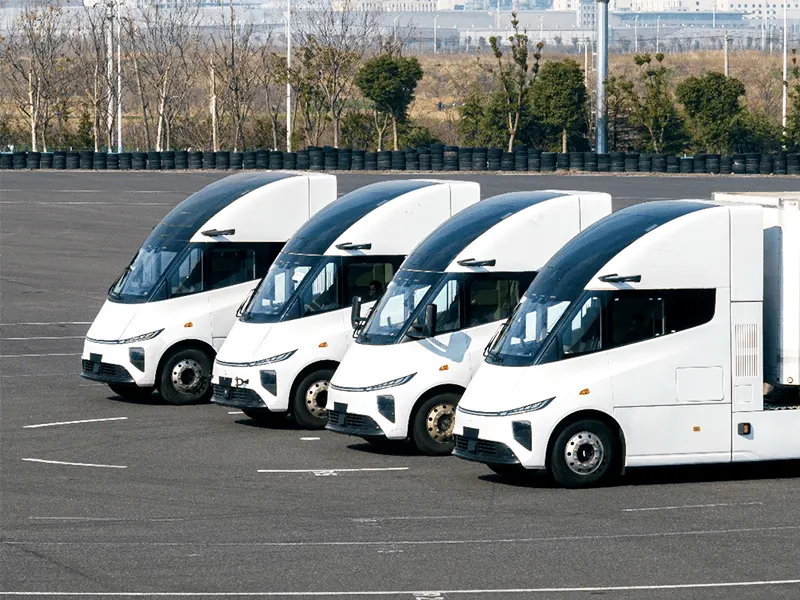
Ranking Analysis: Farizon Remains Number One, FAW Jiefang and XCMG Show Impressive Growth
In November 2025, the Top 10 brands in Hainan’s truck (including vans, excluding pickups and crossover passenger vehicles) market by monthly sales were released. Data shows that Farizon retained its top spot with 234 units sold, accounting for 16.1% of the market, but both month-on-month (-6.8%) and year-on-year (-24.3%) sales declined. Foton followed closely with 145 units sold, accounting for 10.0%, showing double-digit growth both month-on-month (10.7%) and year-on-year (23.9%). Wuling ranked third with 129 units sold, accounting for 8.9%, a year-on-year decrease of 28.3%.
Notably, FAW Jiefang (80 units, ranked 7th) and XCMG (43 units, ranked 9th) showed outstanding growth: FAW Jiefang saw a 56.9% month-on-month increase and a staggering 110.5% year-on-year surge; XCMG soared 138.9% month-on-month and a dramatic 377.8% year-on-year increase, becoming the “dark horses” in the monthly sales rankings.
Monthly Performance: Traditional Brands Recover, New Energy Vehicles Show Divergent Growth Rates
Monthly data shows that traditional gasoline vehicle brands are showing signs of recovery: Foton (145 vehicles), Changan (119 vehicles), Dongfeng (112 vehicles), and Sinotruk (106 vehicles) all achieved positive month-on-month growth (10.7%-33.3%), with Dongfeng showing the highest growth rate (33.3%). While the new energy vehicle brand Farizon (234 vehicles) still topped the list, its year-on-year growth rate declined by 24.3%, indicating a significant slowdown; Wuling (129 vehicles) also saw a year-on-year decline of 28.3%, showing weak performance.
The explosive growth of FAW Jiefang and XCMG is particularly noteworthy: FAW Jiefang, as a traditional commercial vehicle giant, saw its monthly sales double year-on-year (110.5%), possibly benefiting from its new energy transformation strategy in the Hainan market (such as the launch of hydrogen fuel cell trucks); XCMG, as a leader in engineering vehicles, saw its monthly sales increase by 377.8% year-on-year, possibly related to the increased demand for engineering trucks driven by the increase in infrastructure projects in Hainan (such as the construction of the free trade port).
Cumulative Sales Ranking: Farizon Leads but Declines, Foton and Dongfeng Continue to Grow
Cumulative sales data for January-November 2025 shows that Farizon continues to lead with 2,216 units sold, accounting for 14.39% of the market, but its sales declined by 14.0% year-on-year, indicating a gradually narrowing advantage. Wuling (1,816 units) and Foton (1,505 units) ranked second and third respectively, with Foton showing the fastest growth among traditional brands at 22.0% year-on-year. Dongfeng (1,283 units) saw a steady performance with a 16.0% year-on-year increase.
XCMG (440 units) saw a surge of 152.9% year-on-year in cumulative sales, becoming the fastest-growing brand. Its market share increased from 1.13% in 2024 to 2.86%, demonstrating significant expansion. Jiangling (469 units) also performed well with a 41.7% year-on-year increase. Changan (1,164 units) saw a 12.0% year-on-year decline in cumulative sales, and Ruichi (323 units) saw a 13.6% year-on-year decline, becoming the brands with the most significant declines in cumulative sales.
Competitive Trends: A Battle Between Traditional and Emerging Brands, with Opportunities Emerging in Niche Markets
Monthly and cumulative data reveal a competitive landscape in Hainan’s truck market characterized by “recovery of traditional brands and diverging growth rates among emerging brands”:
- Traditional Brands: Traditional gasoline-powered truck brands such as Foton, Dongfeng, and Sinotruk have achieved sustained growth thanks to their channel advantages and product iterations (e.g., the introduction of hybrid and hydrogen fuel cell models). Foton’s cumulative sales increased by 22.0% year-on-year, becoming the “growth engine” for traditional brands.
- New Energy Brands: While Farizon remains at the top, its sales declined by 14.0% year-on-year, indicating a slowdown in growth. New energy brands such as Wuling and Ruichi performed weakly, possibly due to intensified competition in Hainan’s new energy truck market (e.g., the entry of emerging brands like BYD and Geely).
- Niche Markets: Demand for engineering trucks (e.g., XCMG) and special-purpose trucks (e.g., FAW hydrogen fuel cell vehicles) has increased significantly, becoming new growth points in the market. XCMG’s cumulative sales increased by 152.9% year-on-year, mainly benefiting from the development of Hainan infrastructure projects (such as the island-ring tourism highway and the free trade port industrial park); FAW’s hydrogen fuel cell trucks saw increased penetration in the Hainan market (e.g., for port logistics), driving its monthly sales to double year-on-year.
Summary: Remote leads but faces pressure, traditional brands see recovery opportunities. In November 2025, the Hainan truck market exhibited a “stable head, explosive tail” characteristic: Remote maintained its top position, but its growth rate slowed; traditional brands such as Foton and Dongfeng recovered, becoming the core driving force for market growth; and leading companies in niche markets such as FAW and XCMG achieved explosive growth through precise market strategies. In the future, with the advancement of the Hainan Free Trade Port construction, the demand for engineering trucks and new energy trucks (such as hydrogen fuel cell and pure electric trucks) will continue to grow, and the competition between traditional brands and emerging forces will intensify. Niche markets (such as port logistics and urban-rural distribution) may become key for companies to seize market share.